Resilience
In recent years, increasing attention has been paid to the concept of resilience — the capacity to withstand stress, adapt to change, and maintain long-term functioning under conditions of uncertainty. We observe that resilience constitutes a unifying framework across many of the domains addressed by the Solvo Institute. This recognition led to the development of the Individual Resilience Index, the first comprehensive research initiative of its kind in the Czech Republic. The Index assesses resilience across eight distinct dimensions and identifies factors that strengthen or undermine resilience not only within Czech society (the research was conducted in multiple countries), including physical and mental health, value orientations, social ties, economic conditions, and adaptive capacity. The findings of this research are employed not only to enhance understanding of contemporary challenges, but also to inform public debate and support the development of solutions with tangible societal impact.
In this way, Solvo integrates research, education, and societal engagement. Our work is grounded in the conviction that a resilient society begins with resilient individuals, and that high-quality data can serve as a first step toward enabling individuals, families, and communities to better understand themselves and the environments in which they live.
How we did that
At the outset, the working hypothesis was that individual countries would differ substantially in their resilience index scores. We anticipated that Sweden would rank first, achieving an average score of at least approximately 110–115 points. Germany was expected to rank second, with values between 105 and 110 points. The Czech Republic was anticipated to occupy third place, followed by Slovakia at a greater distance.
While the final ranking corresponded to our expectations, the index values of the individual countries differed only marginally. Thus, raising the question of why this is the case.
At the outset, the working hypothesis was that individual countries would differ substantially in their resilience index scores. We anticipated that Sweden would rank first, achieving an average score of at least approximately 110–115 points. Germany was expected to rank second, with values between 105 and 110 points. The Czech Republic was anticipated to occupy third place, followed by Slovakia at a greater distance.
While the final ranking corresponded to our expectations, the index values of the individual countries differed only marginally. Thus, raising the question of why this is the case.
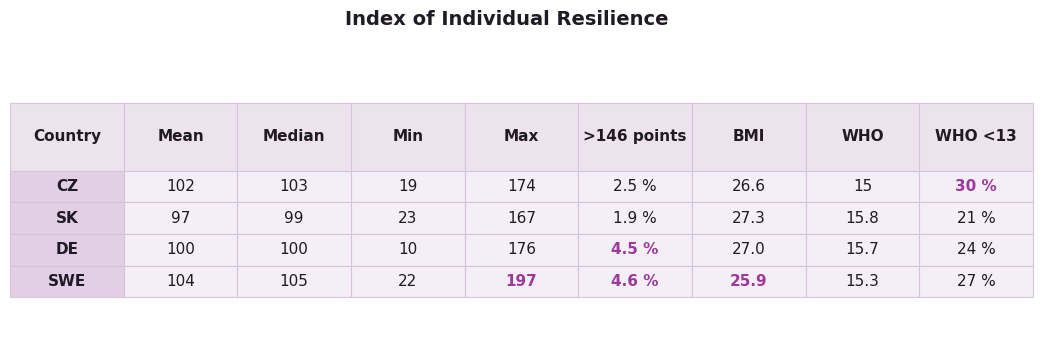
One possible explanation could have been pronounced differences in the underlying distribution of scores. However, an examination of the median as an alternative measure of central tendency, as well as of the observed minima and maxima, suggests that distributional differences alone do not provide a sufficient explanation. At the same time, these indicators confirm that Sweden occupies first place legitimately: the maximum score attained by some individuals reached 197 points, which is substantially higher than in the other countries. Moreover, nearly 5 % of respondents in Sweden achieved markedly above-average index values (more than 146 points). For this reason, Germany’s second-place ranking also appears justified, as 4.5 % of respondents there reached above-average values. In contrast, only 2.5 % of respondents in the Czech Republic and less than 2 % in Slovakia attained similarly high scores.
Just as we expected Sweden to achieve a significantly higher overall resilience index, we also anticipated a markedly healthier population. In this respect, the findings were even more surprising. Although the average BMI was the lowest among the four countries, it still approached 26 points. The mean WHO mental health index score was 15.3 points, which is fully comparable to both the Czech Republic and Slovakia. Moreover, Sweden also exhibited a high proportion of individuals (27 %) whose mental health index score lies at a threshold indicative of potentially more serious psychological difficulties (in this respect, the Czech Republic unfortunately ranks highest, with 30 % of respondents falling into this category).
These findings give rise to a new hypothesis: European countries may be broadly similar in terms of the resilience index because they share largely comparable lifestyles. Alternatively, this similarity may reflect the fact that our analysis thus far has been limited to Central and Northern Europe, regions that are relatively homogeneous, whereas extending the analysis to Southern Europe (e.g., Italy or Spain) might yield different results. Further questions also arise regarding neighboring Poland, which experiences a more immediate sense of threat due to the war in Ukraine, as well as Ukraine itself, which has been defending its territory for nearly four years and has lost a substantial portion of its population.
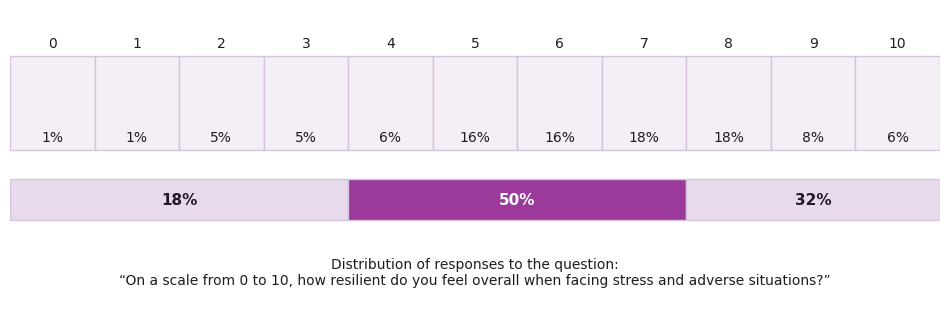
The Resilience Index was constructed by integrating several dimensions into a composite measure: overall resilience reflects performance across individual domains. At the same time, resilience can also be assessed subjectively by asking respondents directly: Do you perceive yourself as resilient, and to what extent? Individuals are asked to place themselves on a scale from 0 to 10. This self-assessment reflects each person’s own understanding of resilience and the relative weight they assign to its components. Some individuals emphasize physical fitness, others psychological strength, and others still skills and knowledge.
Only 2 % of respondents rate their resilience at 0 or 1, indicating very low or no perceived resilience. In contrast, 6 % assign themselves the maximum value of 10, and a further 8 % select a value of 9. Approximately half of the population perceives itself as average to slightly above average in terms of resilience. In light of the results of the overall Resilience Index, this pattern suggests either a tendency toward self-enhancement or, more plausibly, that individuals do not fully incorporate all relevant dimensions into their self-assessment. In particular, aspects in which they perform poorly or lack competence may be underscored, while greater emphasis is placed on areas in which they feel confident.
What, then, emerges when subjective resilience is compared with the overall Resilience Index, which incorporates all dimensions? The two measures are very strongly correlated. Individuals who subjectively perceive their resilience as low achieve markedly below-average index scores, whereas those who perceive themselves as highly resilient also attain high overall index values.

Finally, to what extent is subjective self-assessment of resilience associated with selected health indicators, such as BMI or the WHO mental health index? The results indicate that individuals who rate their own resilience as low are substantially more likely to experience problems related to being overweight as well as psychological difficulties.

What conclusions can be drawn from these findings? They suggest that people can generally be trusted to assess their own capabilities with a reasonable degree of accuracy, and that they are likely able to perceive resilience as a complex construct that encompasses not only strengths but also weaknesses. This, in turn, underscores the importance of illustrating through concrete examples how resilience can be strengthened, even through seemingly simple changes in everyday life.
KEY FINDINGS
Previous researches
Generation Z
The research examined whether widely held stereotypes about Generation Z hold true, including assumptions that they reject long-term relationships or starting a family, struggle with reliability, and face difficulties entering the labor market.
The study was conducted using the CASI methodology via the Ipsos online panel Populace.cz.
Crisis of masculinity
What is it? Does it even exist? Have men gone too far? How do they actually feel? What does it mean to be a man in today’s Czech Republic, and what does “being a man” mean for men and women alike? When was the last time you used that word, and what were you thinking at the time? These are among the questions we explored in the Crisis of Masculinity study, conducted in cooperation with the research agency SC&C.
The Situation of Czech Women in 2023
A CASI-based study conducted via the Ipsos online panel Populace.cz, addressing complex issues of gender equality, generational dynamics, and social structures in Czech society. The findings reveal that generational differences among women often outweigh gender-based differences, and highlight the key role of education in shaping women’s awareness.
Childhood in the Czech Republic
Data from our largest survey to date, Childhood in the Czech Republic. Data collected by SC&C spol.; survey questions developed by our team.
Unlocking potential. Empowering society. ✨
Unlocking potential. Empowering society.
We believe in the potential of Czech society. When it remains untapped, hundreds of billions of Czech crowns are lost. Our goal is to unlock this potential. Join us in doing so—through top-tier data, large-scale research, and unrivalled expertise.